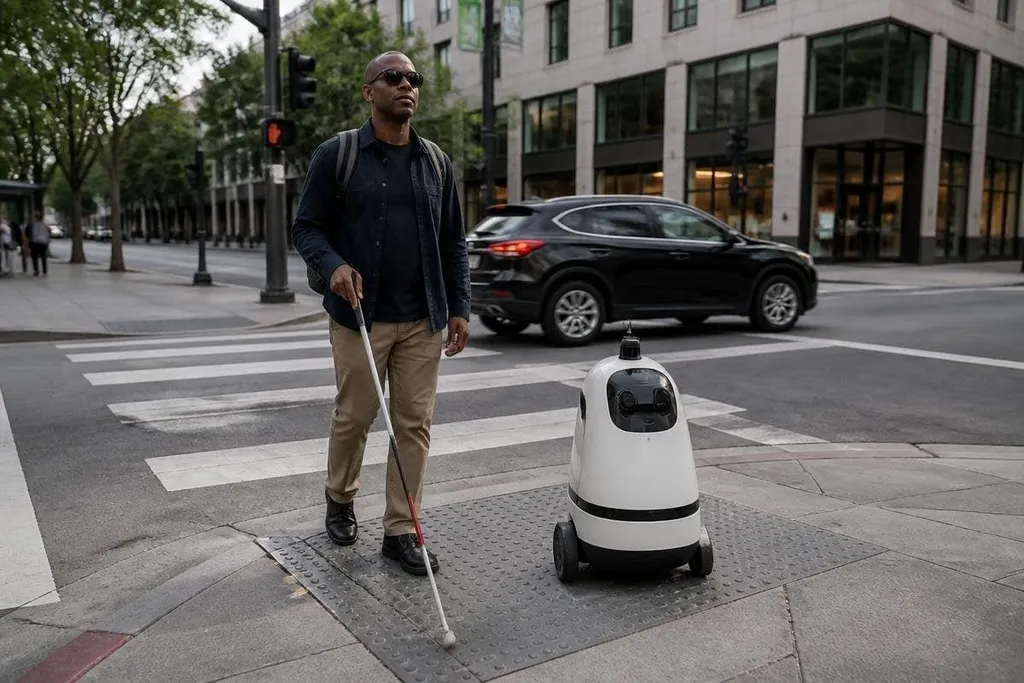
A city-navigation robot would need to do more than avoid walls. It would need to read crossings, notice moving traffic, explain its choices, and give a blind person enough warning to act safely.
No evidence pack names a tested robot or city trial here, so the useful question is what such a system would need to prove.
- A camera and LiDAR could build a map of nearby paths and objects.
- Voice guidance would need to stay brief while the street keeps changing.
- A person must be able to stop, question, or ignore the robot at any time.
What the robot would need to read
The first task is local sensing. Cameras could identify signs, doors, curbs, traffic lights, and people. LiDAR, which measures distance with laser pulses, could show the robot where objects are even when the camera view is poor.
That data would need to become useful instructions. “Turn left” is too vague near a large intersection. A better message might name the curb, the crossing direction, and the sound or signal the person should check before stepping forward.
The robot would also need to update its map as it moves. A parked van can block a familiar path. A delivery worker can leave a trolley across the pavement. Construction barriers can remove the route that worked yesterday. The system has to spot the change and explain a new choice without burying the person in alerts.
Guidance must leave control with the person
A blind person may want different help at different moments. They might ask for a route to a station, a description of the next crossing, or the location of a free entrance. The robot should answer those requests without taking control of the trip.
That means the interface matters as much as the sensors. Voice output needs clear priority rules: an immediate hazard comes before a street name, while a minor object may wait. Physical buttons, a phone link, or a wearable control could give the person a fast way to pause the system.
I’d treat any city-navigation robot as an aid, not as a guide whose instructions can go unchallenged. A person still needs a way to check the scene through sound, touch, or another trusted method.
Where the hard failures happen
Indoor routes are easier to describe than busy streets because buildings usually have fixed walls, doors, and corridors. Outside, the robot has to deal with noise, poor lighting, temporary barriers, bicycles, vehicles, and people who do not know the robot is assisting someone.
A wrong label can be worse than no label. If the system calls a road crossing safe when it has missed a turning vehicle, the problem is not a bad route. It is a safety failure. Designers would need tests that measure missed objects, false warnings, delayed alerts, and the time a person needs to react.
Privacy adds another limit. A camera pointed along a street may record faces, license plates, and shop fronts while looking for a curb. Any product would need a clear rule for what stays on the robot, what leaves it, and how long data remains available.
For blind travelers, a useful report names the route, weather, people tested, failures, and who checked the result. Robotics reporting at Robot24.com can show whether a system worked on a street or only in a lab.
What a serious trial should show
A city trial should report more than a smooth video. Before you trust a system, check these points:
- Route conditions: Were tests run at crossings, bus stops, construction zones, and quiet pavements?
- Failure records: Does the report list missed hazards and false alerts, rather than only successful trips?
- User control: Can the person stop the robot, ask for the reason behind an instruction, and choose another route?
- Human support: Is a trained person present during tests, and what happens when the robot loses its map?
- Privacy rules: Does the maker state what camera and location data it stores?
- Access plan: Can a person use the robot without a subscription, phone, or help from another person?
Those checks would tell you more than a claim that the robot makes travel easier. The open question is whether the system can stay useful after the street stops behaving like its test route.
Until a named trial publishes those results, robots for blind city travel belong in careful testing rather than daily dependence. The next proof should be an unedited route report that shows what the robot missed, how the person recovered, and who stayed in control.